


You’re reading a blog post on Ian Taniels’ 1000 projects! These come out on Saturdays. Tuesdays are for my serial/debut novel. Check out the House of Chapters: Home of Serials.

We’ve probably all been there
by Ian Taniels | HouseOfChapters
We write our heart out, carefully crafting, lovingly putting the finishing touches on feelings, ideas, stories transformed into words. Satisfied (or full of dread), we hit that button:
Publish.

Last night, I picked up my handwritten journal for the first time since September. I hadn’t written in it since I created my publication and the House of Chapters.
I almost feel embarrassed to share that when a sentence came out well, I kept thinking “oh, maybe I can turn this into a post”, before telling myself to shut the hell up. It’s been a rough couple weeks. The truth is - and maybe you feel like that too: if I didn’t want anyone (*cough* as many people as possible) to read my stuff, I wouldn’t post it online.
At this point, I need to specify that it’s possible to have a Substack just for fun, write blog posts or an online journal and really not care about being read or getting feedback.
I believe fiction writers have a different way of looking at things. I’ve actually talked to a lot of authors while working on Serials of the Week posts or the Infinite List of Serials. Many agreed that genuinely connecting with other authors, reading each other’s work and getting feedback is one of the best aspects of this platform.
So why isn’t there more of it?
After last week’s post Is Substack the Right Place for Serials? Randy M and I decided to work together on this post to compare another platform - where feedback works, but other stuff doesn’t - to Substack, where a lot of stuff works, but feedback is rare.

Scribophile vs. Substack
by Randy M
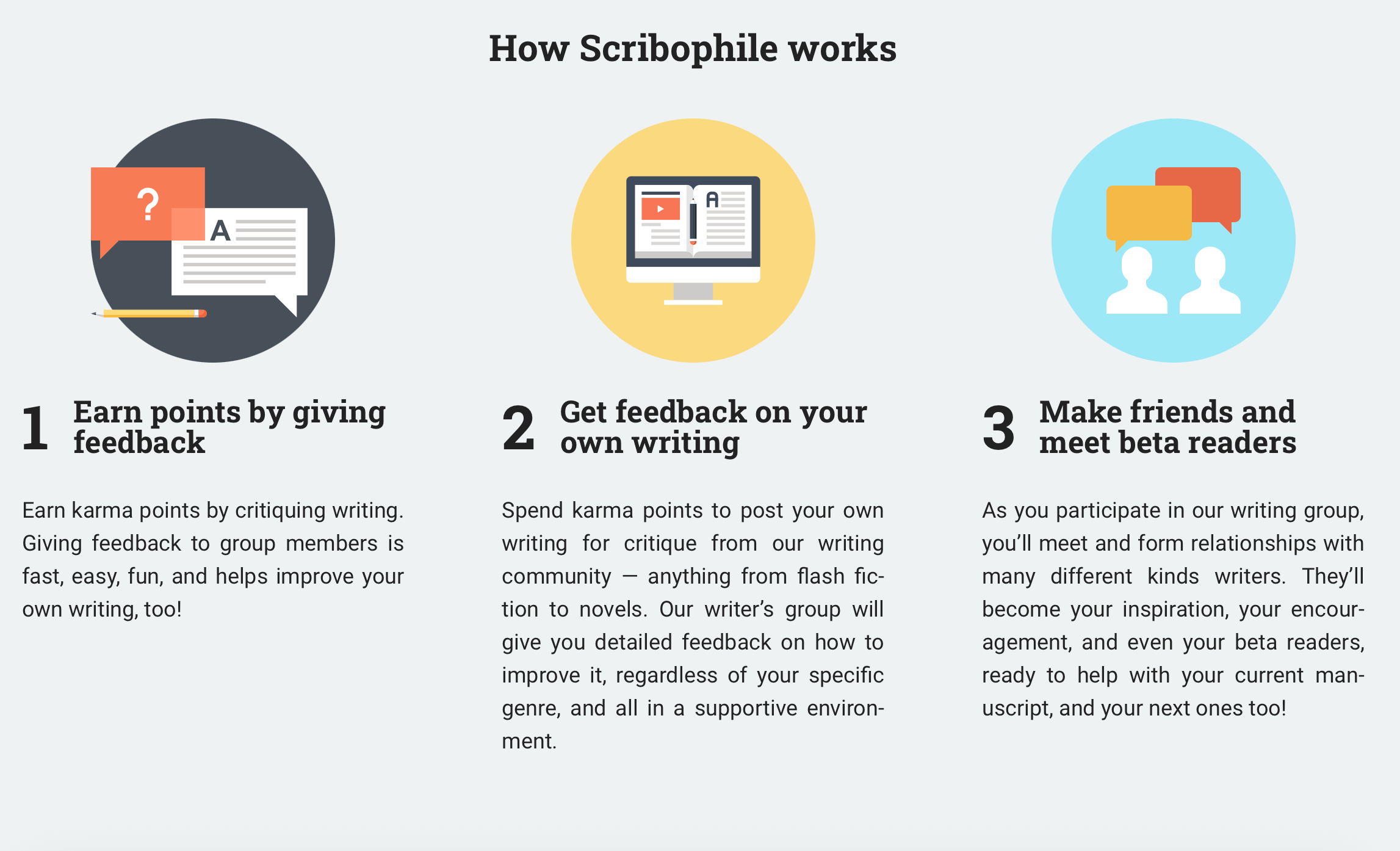
Scribophile.com is set up to require 3 comments on every entry (a <4k word section, often of a novel, but could be an article or poem or short story) before it leaves the queue and makes room for others. So without constructive engagement, the site simply doesn’t function.
When leaving a critique, you will read the following: “Critiques at Scribophile are required to be mostly constructive criticism — that is, actionable ways for the author to improve. Critiques are not rewriting the author’s work for them, but rather they’re using your words to tell the author how to improve on their own.”
Marked failure to do so means your critique is removed, you lose the credit for it and another slot is opened up. Additionally, each critique has on it “like” buttons indicating what a good one is: Thorough / Enlightening / Encouraging / Constructive / Like. Seeing these each time you submit reminds you of the goal of the feedback.

Substack is a different place and we don’t have a desire to turn it into a critique circle; this is a place for publishing. But it would be nice to have a bit more enlightenment or encouragement, no?
I think Substack has a couple of things going against it here. Best case: we see each other as fellow published or aspiring authors, not necessarily as peers who’ve come together for improvement. Worst case: we see each other as competition.
It’s less clear what kind of comments would be helpful or welcome, perhaps because of that element of competition, though honestly I’ve not seen that. Also, since critiques aren’t required we never go through the challenging exercise to build good analytical “muscles” and it can feel lame to just leave another comment saying “I liked it” or maybe “I love the idea and the characters but I have one question…”.
Culture also matters
by Randy M

On Scribophile, one can cultivate a group of partners that has higher trust and familiarity, and the universally agreed position is that this vastly improves the experience.
The site has “private spotlights” (an interesting contradiction) to facilitate this, but use of them relies on the user to seek out those they wish to interact with, through social graces, reciprocity, genuine mutual interest, and the ability to accept no.
These skills can be employed on Substack for the same purpose. They aren’t going to guarantee you anything, especially not short term. The goal is shifting the culture, not immediate payment in kind.
So it helps if you recognize that you benefit from performing the sincere, constructive analysis on other work as much as you do from receiving it. And it helps if you genuinely appreciate something in the work of other writers, and enjoy discussing their ideas and craft.
Don’t approach it from a perspective of “one more way to get publicity.” That way, even if the cultural shift ends up being slight, you have grown and enjoyed the process.
That’s my approach, anyway. There’s a temptation to cast a wide net, read many, many people superficially and hope they’ll return the favor, but slowing down seeking depth over breadth is in my opinion a more enriching approach.
A New Feedback Culture on Substack: Triple R
by Ian Taniels | HouseOfChapters
So what now? I want to conclude this week’s blog post with actionable advice in the hope of encouraging a new kind of feedback culture on Substack. These three points are related to Lesson 9 & 10 from the 12 Lessons We Learned Writing Serials.
Realize what you’re doing here (writing fiction for example) is not unique, but it can be just as special as what others are doing. So connect to others and learn to care about other people’s stories.
Read other people’s work (no matter the amount of subscribers!) and leave a comment: something you liked, a quote, an idea. There is always at least one quote you can share - trust me, I know.
Reach out to other people. Today. Write a DM or comment to someone with a similar or slightly bigger subscriber count, similar genre: “Hey, I saw that you’re writing a serial / short stories / etc., too. I’d love to read something of yours and give you feedback, would you be interested in doing the same?” You’ve got nothing to lose. The code of conduct from Scribophile can help.
This is possible without a middle-man, but if you need one, I’d like to point out the wonderful experiences many authors from the House of Chapters have made participating in the Reciprocal Reading Events in January and March. If you’re interested, you can always join:

What about you? Let us know!
Got any tips on how to get feedback online ?
Have you had positive experiences regarding feedback on Substack?
Do you want feedback or are you happy just writing?
Did we miss something important?
 | A guest post by
|
Just to clarify, "critical" usually means negative, but that's not necessarily the point we were trying to push people towards, particularly for public comments with someone you aren't familiar with. Those can be done, with careful grace. "Did you mean to imply X, or am I missing something?"
But a critical eye can also uncover a clever turn of phrase or or moving line or deft use of theme or whatever.
One thought - in your opening, you mention the last step is hitting publish. But what if...what if you publish, and then the last step is to post a comment on your own story, stating what type of feedback you're looking for? (Or simply add to the end of your story).
If you're looking for critical feedback, let us know!!